Saturday, 25 November 2017

Production: Ancillary Posters V1

After asking my focus group which image they prefer I used two of my images which they identified as their favourites to produce a final piece for each. I will then change elements on the posters and gain audience feedback on the final pieces and decide on an end product. 

Thursday, 23 November 2017

Production: Ancillary Poster Pt1

I added my chosen font and text: "Fighting for First, New Documentary, Starts tonight 10pm" On top of a white box in my chosen carefully researched and downloaded font. At the moment I have decided to keep the colours plain and simple, I will soon try some different variants. I can now add this to my other images to see which one works best and gain some audience feedback and see which variant my focus group like best. 


Production: Ancillary Poster Image Editing

I wasn't happy with the colours or exposure of one of my images so I decided to improve the quality of it in Adobe Lightroom. I slightly decreased the exposure to make the image less bright,  I then upped the contrast to make the colours pop more. I also played about with the Highlights and Shadows until I was happy with how they where exposed before changing the Whites and Blacks. I also bumped up the Clarity as I like the way it adds a dirty look and I feel this is suitable to the image as it shows grit and determination. 
 

Production: Channel 4 Font

I had a look on a variety of websites and it has come to my attention that many people have had a similar problem to what I have encountered. However I found a page that recommended a font supposedly similar to the channel 4 font so I found a website to download it and installed it on my mac. 

The Font recommended is: Etelka Pro. I found a variety of styles of the same font that I will be able to use for different parts of the product. 


Audience Feedback: Images for Ancillary Poster

I asked 2 members from my focus group which of my 4 chosen images they preferred. They both gave different responses so I will focus on these two images. I will still however, make an example for all 4 images then get feedback on what they prefer as a finished product.  


Production: Ancillary Poster Images

After searching through all my images and footage I have narrowed it down to 4 best potential images to be used for my Ancillary Poster. These images are as follows: 
1)

2)

3)

4)

I will use all of these images to produce an example of an ancillary product and decide upon the best one with the help of my focus group to give audience feedback. 

Monday, 20 November 2017

Production: First Edit

Production: Adobe Media Encoder

Another programme I have used is Adobe Media encoder. I used this to export my videos from Premier Pro as this allows me to choose all of the export settings. I can choose the frame rate along with the resolution etc. 

Tuesday, 14 November 2017

Observation: Micro Elements

In my interviews I have included very specific costumes in order to show the generic conventions of a cyclist to make him easily recognisable. I asked my model to wear a Castelli top (which is a well known cycling brand) and specific bottoms along with other extra items such as helmet and gloves.

I also filmed the interviews at a cycling specific location in order to add to this to keep it authentic. 

Saturday, 11 November 2017

Production: Logo overlay

In order to overlay the channel 4 in my documentary I found an image of it online. This was a JPEG with a white background which I wanted to remove. In order to do this I opened the image in photoshop on a transparent canvas and used to magic want tool to remove the background and then exported it as a PNG file to keep the transparent background.

I will also be able to overlay this image on my ancillary products. 

Thursday, 9 November 2017

Production: Archive footage

I have gone on youtube to get some archive footage of the olympics to help add to my narrative. I found a clip that I found relevant and used Quick time player to record a section of it from which I will pick and choose what specific small parts I want to use by cropping and cutting it in Premier Pro. 

Sunday, 29 October 2017

Production: Checking Audio Quality

As the audio on my footage is extremely important especially on the interviews I have exported a small section of one of my interviews from PremierPro to check that the sound is clear and also to check that there is not background noise as even though I used an external microphone on my DLSR with a windshield it was filmed at a MTB track so could be windy.  


Audio from Interview from George Crocombe on Vimeo.

Generic Research: The long Tail - Chris Anderson

The 'head' of the graph is the more popular products that are purchased by a lot of people very regularly. 

The 'tail' of the graph is the more niche products that are very specific and much less popular. This in theory will continue exponentially getting closer to 0 but never reaching it as a product will always have some sort of market regardless of how small. 

This relates to the film industry as in modern day people are watching more niche films and programmes so are going out of their way to find and watch what they want rather than just sitting through whatever mainstream product comes on on TV hence why sites such as Youtube have seen a massive increase inn traffic over recent years. 

Friday, 13 October 2017

Generic Research: Media in the Online Age

Today in our lesson we read a section from a textbook entitled "Media in the Online Age" It included details on 'The long Tail' and "Wikinomics' both of which have helped deepen my general knowledge of how media is consumed and received in the current day and how things change. 

Thursday, 12 October 2017

Research: Ancillary Poster C4

I wanted to find out what font was used for the official Channel 4 Posters so I can keep a consistant house style from my documentary and keep it authentic to the channel.  So I used Google Chrome in order to try and shed some light. While doing so I came across this document from Channel 4 themselves called the Channel 4 Identity style guide. 

It lists the conventions that must be followed in order to produce a piece that follows the recognisable style. 
It then goes on to explain how Channel 4 stray away from the generic convention of placing their logo in the bottom right hand of a piece and instead have it placed in a central position on the right hand side. This creates a very distinct look and is something I must use in my products. 


Another point mentioned is how the Logo must not be in any way modified. I will follow this 'rule' when producing my products. 
The next point mentioned in the document is the colour use for the logo. They provide a list of colours and Pantone codes that are allowed to be used for the logo. It then goes on to mention that any colour can be used when the image is overlaid on an image. This is important as it means I can use any colour in some of my products when the logo is on an image but when placed on a plain background I must use one of the specified colours. 
 

The document also states the font "C4" that has been specially commissioned for the organisation and use by them. I wanted to use this font to keep the style consistent. However after some research it seems that this is not possible as there is nowhere that allows this font to be downloaded so I will have to search for something very similar. 


Tuesday, 10 October 2017

Planning: Online Risk Assessment Form

I found a Filming Risk Assessment form on Google which was on as a PDF and already filled in with the details of the other company. This was much more suited to my needs than any other forms I had found in word. 


In order to edit it I had to use Adobe Acrobat to convert from a PDF document to a word document.

Monday, 2 October 2017

Generic Research: Dochouse Cinema

Dochouse is a cinema that show only documentaries in the cinema. I used this website to check the conventions of many different types of niche and mainstream documentaries to help me follow them correctly in my work.


Saturday, 30 September 2017

Production: Stabilising Footage

After reviewing some of my footage I realised that some of it is very shaky which is noticeable when edited together and really doesn't look very good as it distracts from what is on screen and just looks very amateur. 

To solve this I have used Adobe After Effects and within this the Warp Stabiliser tool. I found a Youtube tutorial on how to use this and after watching it applied it to a number of my own pieces of footage before putting them into Premier Pro for assembly.


Friday, 29 September 2017

Production: Title Shot


I have decided to open using quite a long shot of my main character riding. This pans across and tracks him onto the rocky feature. I decided to use this as I feel it is a nice shot to open with as it is quite slow paced but at the same time I like the calm effect this gives. I also like the audio of the tyres on the surface as I feel this really adds to help establish the documentary as it is a very unique sound that tells the audience exactly what is going on straight away. I have also added the title of my documentary to the first shot on the timeline. I have done this using the graphics section on premier pro by choosing the title graphic I like then replacing the text and font with my own. I also then added a transition effect to make the title fade off the screen as I didn't like the way it disappears all of a sudden. 

Thursday, 28 September 2017

Production: Colour correction of footage

After reviewing my footage I decided that I needed to correct the colours and exposure. I did this using the colour editing section on Premier Pro. 

I have increased the contrast and saturation of most of the footage to make it more vibrant and punchy, I feel this has greatly improved the quality of the footage as it looks considerably better than how some of it did before as the colours looked slightly off. I have also on some of the footage that is in the woods decreased the tone of the whites and increased the tone of the blacks as this means that the darker parts of the video caused by the lack of light are easily visible but the bright parts where light comes through aren't over exposed. 

I haven't adjusted the colour balance (temperature or tint) as the weather that I filmed in had good lighting and the white balance on my camera was set accordingly.

Wednesday, 27 September 2017

Audience Research: Focus Group


Production: Things I've noticed during filming

While filming at a race gathering the majority of my shots for my work I have noticed that people tend to act differently around me when I am using or holding what appears to be professional type equipment. By this I mean it has come to my attention that particularly during the race the riders will sit up and make it clear they are making more of an effort when they see the camera as they immediately assume the footage of them will be used for work that may well be available to the public. 

I have also filmed some footage on my iPhone 7 as this allows me to get 120fps slow motion footage and I've noticed that this same effect does not happen as people just think its someone filming their family or friends. 

This could mean that using a big camera could affect the representation of the sport and my documentary as people act differently when the camera isn't there. 

Friday, 22 September 2017

Research: Theorists

Types of Narrative theory: 

Todorov - Equilibrium, Disequilibrium, new equilibrium. 
When the equilibrium is broken there is first a realisation that is has been broken then an attempt to restore it is made or a new equilibrium has to be created. It can be broken down into 5 Stages: Equilibrium, Disruption, Recognition, Repair, Restoration.

Levi Strauss - Binary Oppositions 
All narratives are based around the conflict between such binary opposites. 
Good vs Evil, Human vs Nature, Black vs White, Protagonists vs Antagonists, Humanity vs Technology, Man vs Woman, Human vs Alien.

Roland Barthes - Enigma Codes 
Any element of the story that is not fully explained 

Propp - Common character roles in narratives. 
Found that most texts have the same characters consisting of: 
 - The hero (who seeks something usually to restore order) 
 - The Villain (who seeks to cause disruption) 
 - The Dispatcher (who helps the hero to restore order by setting them on their way) 
 - The Donor (who aids the hero by giving them something) 
 - The False Hero (who disrupts the hero with false claims etc) 
 - The Princess (who acts as a reward) 

Stuart Hall - Reception theory - Audience encoding and Decoding 
Dominant Reading - When the audience fully share the codes presented in the text, not necessarily what the author intended. 
Preferred Reading - What the author wants the audience to perceive from the text.
Negotiated Reading -  When the reader only partially shares the codes of the text but partially modifies it to reflect their own experiences. 
Oppositional Reading - When the audiences past experiences means they receive the text in the exact opposite way to which the author intended. 


Monday, 18 September 2017

Production: Race footage

I attended a race at the weekend at which I have completed most of my filming. I decided against getting interviews at the race as the sound would have been compromised as the venue was very loud and although I have an external microphone on my camera the interview would have been hard to hear. 

This location was a regional MTB race at Langdon Hills country park in Essex. 

Saturday, 16 September 2017

Planning: Interview Questions

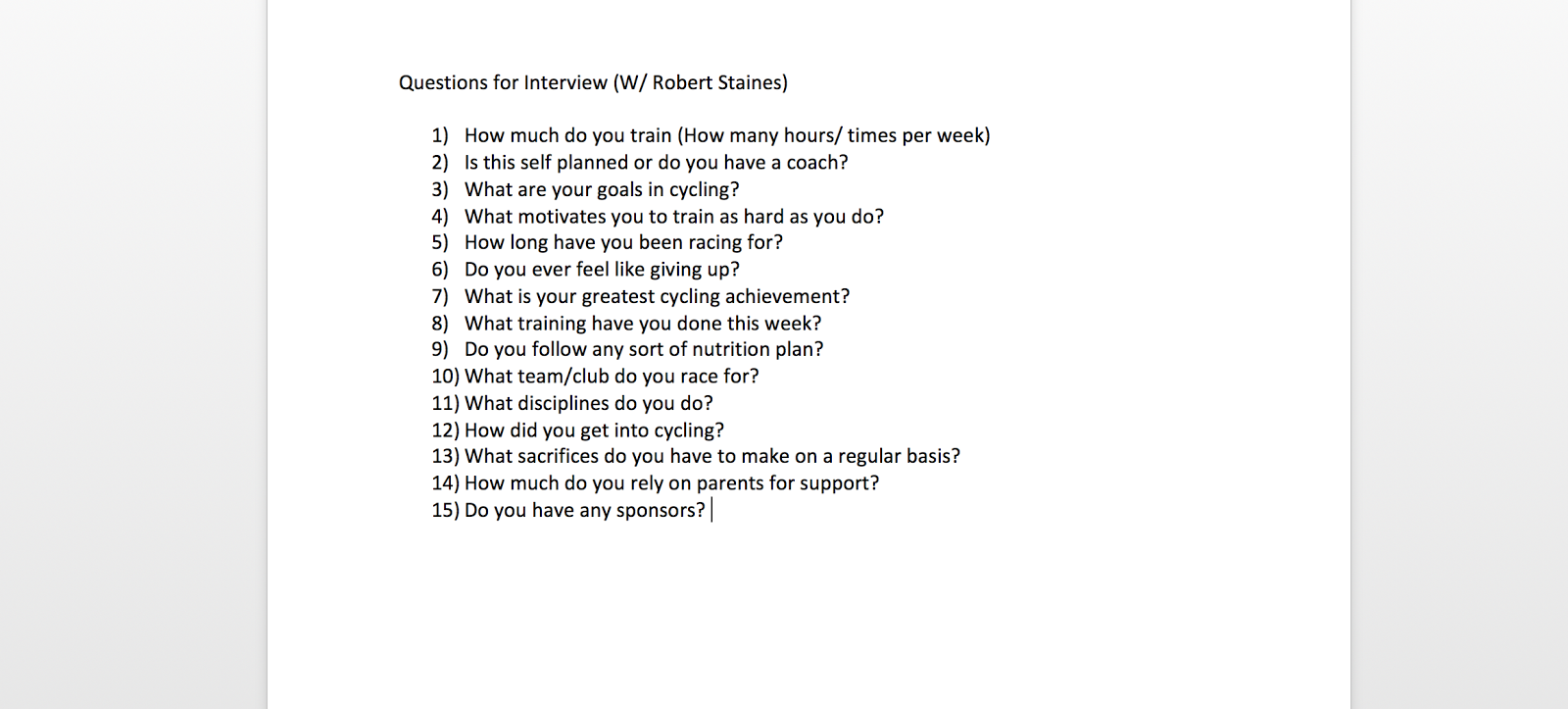
Before meeting with my actor to get my interviews I wrote out a list of questions for him to answer in order to ensure he answered with all of the information I need to add to my narrative structure in my documentary. I also asked leading questions that allow for more detailed expanded answers.

Friday, 15 September 2017

Planning: Costume for Actor

I got in contact with my main actor before meeting with him to get some footage and interviews from him. I asked him to wear specific clothes in order to address the micro elements of my documentary. I asked him to Long Sleeve "castelli" top as this is a very well known cycling brand and also long tights as these are specific to cycling and in addition to this helmet and anything else he would usually wear while training to keep it authentic.  

Wednesday, 13 September 2017

Production: Cut Away Footage

I met with my main actor Robert Staines at my location to film clips of him riding on the track. These are all fast paced clips that will be on screen for only a few seconds. I will use these to be played over the audio from my interviews in place of the images of the interview as if these are displayed on screen for too long it may become too boring, to prevent this from happening I will keep the editing fast paced with these cut aways. 

Planning: Contacting artist for permission

I have started making enquiries with agents to get the correct permission to use their songs in my documentary. 

I was only able to find a mobile number for anyone related to Eminem and I decided this was not a formal way of getting permission to use his music so I decided to try and get an Email address to speak to. 

Research: Narrative Structures

Linear: (Sequential) Events go in chronological order. Help audience to follow events easily.

Non-Linear: (Non Sequential) Events portrayed in non chronological order. Makes the audience more confused during the events linked together at the end. 

Realist: Believable by the audience because they may appear to be real events and are based on a true story.

Anti Realist: Not compatible with reality, may use lots of special effects and editing to achieve this. 

Open Endings: When the audience is left in suspense at the end of the programme, this leaves them questioning what might happen next. 

Closed Endings: When the audience gets a conclusive finish and no questions are left un answered.

Narrative Devices: Used to add to the narrative making it more interesting, for example cliff hangers and flashbacks. 

Flashbacks: When an event that has already occurred in the past is put into a scene that is in the present day. 


Research: Conventions of Documentaries

Actuality footage: Recording of an actual event and documenting it, real people involved not actors. 

Voiceover: A not seen commentator that explains events or storylines through the documentary. The audience are encouraged to take what they say as the truth. 

Narrativisation: Used to communicate events using a narration to help the audience understand the proceedings better. 

Interview: Allows people being filmed to give their account of events directly to the camera. They can be prompted by specific questions. They can help to give a sense of realism and helps convey emotion as it is much clearer to the audience when they are looking directly into the camera. 

Text: Inserting information, times dates etc. More common in newer programmes, quick way of conveying information to the audience or give further information. 

Sound: Helps give off a certain effect or give a mood to the documentary. 

Dramatizations: Reconstructing an event by actors to make real events that where not captured on camera visible to the audience helping to give them a further insight.

Realism: Can be achieved through the use of archive footage, interviews and location shooting. 


Saturday, 9 September 2017

Planning: Locations

I plan to film my footage at a number of locations and events as I want to get a variety of shots of my subjects in different locations and situations 

Langdon Hills Country Park: 
Mud Sweat and Gears Regional Race 


Hadleigh Park:
Cycing centre 

Belfairs Woods:
Public woods
h
Westcliff -on-Sea: 
One of my subjects home address

Tuesday, 5 September 2017

Planning: Questions for Interview

I have written out a list of questions that I will ask one of my subjects, in this case Robert Staines when I come to interview him. I have quite an extensive list as I want to make sure I get a good in depth interview and don't leave anything un answered, however if needed I will be able to get more interviews and footage in the future if I realise that I need it. 

Friday, 1 September 2017

Planning: Equipment

In order to ensure my footage is of the highest quality I will be filming on my DSLR camera as this will give footage that is 1080p but also a good frame rate ensuring that the footage is smooth as this is important as parts of what I will film will contain very fast moving subjects due to the nature of MTB racing. In addition to this it allows me complete control over the ISO shutter speed and most importantly aperture which will allow me to either get a deep depth of field to have a large amount in focus or a shallow depth for example when doing an interview and I only want the one subject in focus at the front of the shot. The ISO will allow me to ensure that the shots are all perfectly exposed. 


I have also purchased an external microphone for the camera to ensure I get good quality stereo sound for my interviews but also to capture the atmosphere of a race as this will greatly add to the documentary.  In addition to this I have also ordered a stabiliser which will allow me to get smooth shots which will be essential to producing a professional quality piece of work as holding the camera by hand will lead to very shaky shots which is not ideal.